🚀 Why Fast-Growing Companies Struggle With Tech Execution (And How to Overcome It)
Many ambitious companies launch with strong ideas, passionate teams, and the right funding. Yet, when it comes to execution, technology often becomes the biggest roadblock. This doesn't stem from a lack of talent — it's usually the result of misaligned priorities, short-term fixes, and overlooked scaling needs.
The 3 Most Common Execution Gaps
1. Endless Development Cycles
Products get stuck in development for months — sometimes years. Features get added, but the actual release keeps slipping.
Why it happens: Over-engineering for problems not yet faced, lack of clarity on "minimum viable" features, teams working in silos without strong leadership alignment.
How successful companies solve it: Establishing clear MVP boundaries with a "business first" mindset, building lean but scalable architecture that allows iteration, enforcing strong communication loops between leadership and engineering.
2. Technology That Collapses at Scale
A product may work fine with a few thousand users, but once adoption spikes, systems begin to fail — slow response times, frequent downtime, or transaction failures.
Why it happens: Early technical decisions focused only on speed, not scalability; underestimation of infrastructure needs; lack of proactive monitoring and optimization.
How successful companies solve it: Designing with scaling in mind from day one (cloud-native infrastructure, modular architecture), stress-testing systems under projected peak loads, implementing automated scaling and redundancy.
3. The Leadership-Engineering Gap
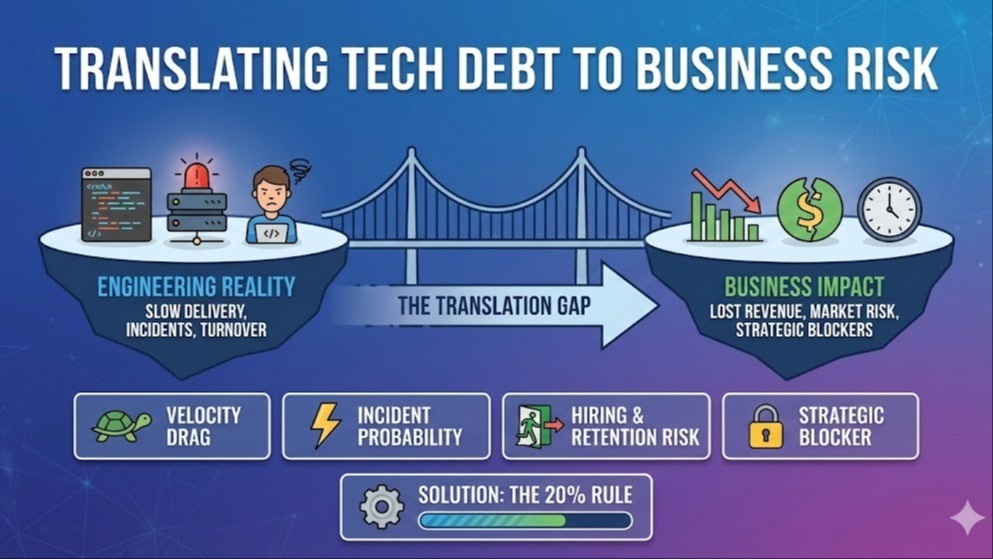
CEOs and COOs often find themselves acting as translators between business goals and technical teams. This creates frustration and slows execution.
Why it happens: Leadership speaks in market opportunities; developers speak in code. Misalignment on priorities leads to rework.
How successful companies solve it: Empowering technical leads who understand both business and engineering, converting high-level goals into clear actionable technical roadmaps, regularly aligning progress to business outcomes — not just technical milestones.
The Business Impact of Poor Execution
When execution breaks down, the cost is much higher than the development bill:
- Delayed go-to-market → competitors capture market share first
- Lost customer trust → users abandon unstable products
- Burn rate inefficiency → resources spent on rework instead of growth
- Leadership distraction → time lost on technical firefighting instead of strategy
For scaling companies, these hidden costs often matter more than direct expenses.
Building Tech That Enables Growth
Organizations that succeed consistently treat technology as an execution partner — not just a cost center. The shift happens when leaders ensure:
- Speed and stability go hand in hand → products reach market quickly but are resilient enough to grow
- Teams speak the same language → business vision translates seamlessly into technical delivery
- Scalability is planned, not patched → systems built to handle tomorrow's success, not just today's traffic
Final Thought
Great ideas fail not because of weak markets, but because execution didn't match ambition. For CEOs and COOs, the focus should be on ensuring technology doesn't become a bottleneck, but rather a growth accelerator.
That means prioritizing lean builds, scalable systems, and strong bridges between business and engineering. Companies that get this right don't just launch — they lead.
Originally published on LinkedIn
Related reading
- The Hidden Reason Most Tech Projects Fail — How Smarter Execution Fixes It
- Beyond Time Zones: The Engineering Playbook for High-Performance Distributed Teams
- Stop Treating Security as a Bottleneck: The "Shift Left" Approach to High-Velocity Engineering
- Why I Stopped Charging Hourly and Started Charging Per Milestone — And Why My Clients Prefer It
Need a senior engineering voice in the room?
Fractional CTO work: architecture calls, hiring, vendor review, and translating engineering risk into language your board acts on. Usually a few days a month, not a full-time hire.