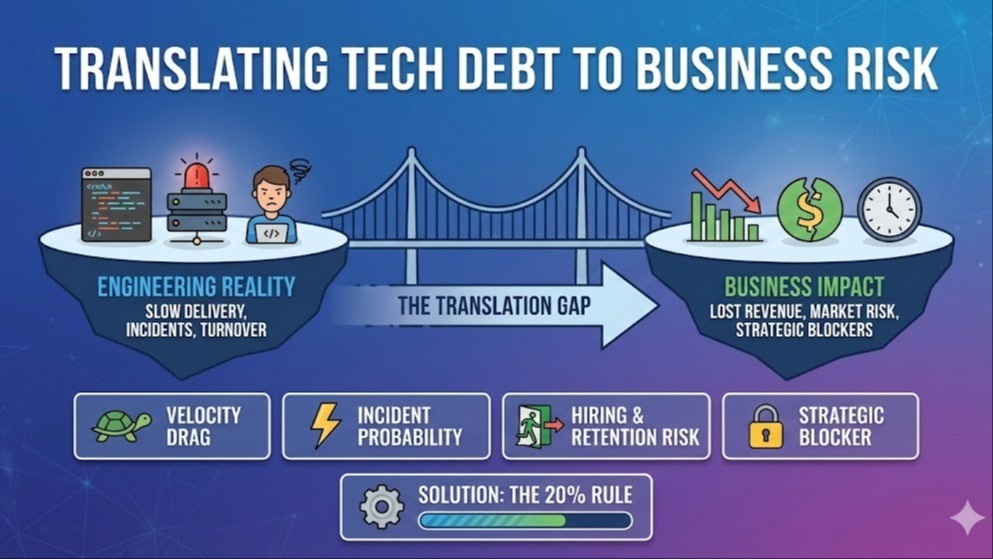
The Real Cost of "Quick Fixes": How Technical Shortcuts Become Business Debt
A founder recently told me: "Our developers keep saying we have 'technical debt' and need to stop building features to fix it. But we have a product launch next quarter. I can't afford to stop."
I told him: "You're not hearing a technical request. You're hearing a risk warning. And every month you ignore it, the risk compounds."
The problem isn't technical debt itself. It's that nobody is translating it into the language the business actually uses: risk, cost, and velocity.
What Technical Debt Actually Costs (In Business Terms)
It Slows Down Feature Delivery
In a codebase with high technical debt, feature delivery velocity is typically 2-4x slower than in a comparable clean codebase. That means your competitor — with the same team size and the same feature ideas — ships 2-4 times faster than you. Not because they have better engineers. Because their engineers aren't fighting the codebase.
It Increases Incident Frequency and Severity
In one client's platform, a "quick fix" from two years ago had introduced a race condition in the checkout flow. Under normal traffic, it was invisible. During a promotional event that tripled traffic, the race condition triggered for approximately 2% of transactions — resulting in double charges.
The incident took 14 hours to diagnose and fix. Quick fixes create hidden failure modes that surface at the worst possible time — during peak traffic, during a product launch, during a fundraising demo.
It Makes Hiring Harder (and More Expensive)
Strong senior engineers can assess a codebase within the first week. If they see extensive tech debt, many will leave during the probation period. One company I worked with hired 5 senior backend developers — three left within 3 months citing "unmaintainable codebase." The cost of recruiting, onboarding, and losing those three engineers exceeded $100,000.
It Blocks Strategic Initiatives
- Want to add AI features? Your data layer may be too tangled to feed structured data into a RAG pipeline.
- Want to expand to a new market? Your auth logic scattered across 15 files makes compliance changes a minefield.
- Want to raise a Series B? Technical due diligence will assess your codebase — significant technical debt directly reduces your valuation.
The Framework: Translating Debt into Business Risk
When I work with leadership teams, I present technical debt in a format they can evaluate alongside other business risks:
Velocity Drag: "Our current tech debt is reducing feature delivery speed by an estimated 40%. The 6 features planned for Q2 will likely take until Q3. If we invest 4 weeks in targeted debt reduction now, we recover most of that velocity."
Incident Probability: "We have 3 known areas of fragile code in the payment and user authentication flows. Based on the last 6 months, there's a meaningful likelihood of a production incident. The estimated cost ranges from $15,000 to $50,000 depending on severity."
Hiring and Retention Risk: "Our last 2 senior hires cited codebase quality as a concern during exit interviews. We're spending roughly $25,000 per senior hire in recruitment costs. If codebase quality continues to be a retention issue, we're likely to see $50,000-100,000 in annual recruitment waste."
The Pragmatic Approach: The 20% Rule
I don't advocate for "tech debt sprints" where the team stops building features. Instead, I implement the 20% Rule: every sprint, 20% of engineering capacity is allocated to debt reduction. This is not negotiable and not deferred when deadlines are tight.
How it works:
- Prioritize by business impact, not engineering preference
- Attach debt reduction to feature work — when building a new feature in a high-debt area, clean up that area alongside the feature
- Track the results — measure feature delivery time, incident frequency, and deployment frequency before and after
- Make it visible — every debt work item has a ticket, every ticket has a business justification
Over 6-12 months, this steady approach produces a dramatically healthier codebase without ever requiring a "feature freeze."
Originally published on LinkedIn
Related reading
Built your MVP with AI? Get the architecture reviewed before it breaks.
I will review your prototype's backend and send you the three things that will break first at 10K users — what fails, why, and what it costs to fix now versus later. No call required, no pitch.