🚀 From Vision to Velocity: How Thoughtful Engineering and AI Turn Products into Business Growth
When a product stops being an experiment and starts being the business, the questions change. It's no longer enough to ship features — you need systems that accelerate decision-making, reduce risk, and compound value month after month.
1 — Start with Outcomes, Not Components
Engineering decisions should map directly to business outcomes: adoption, retention, revenue, operational cost, and time-to-market.
- Which user behavior most directly drives your revenue?
- What minimum capability must work perfectly on day one?
- Which parts can be shipped gradually, and which must be rock-solid from launch?
When engineering work is prioritized by business impact, every sprint becomes a step toward measurable outcomes — not just a list of technical tasks.
2 — Build Systems for Change, Not Nostalgia
Fast-growing businesses pivot. Requirements shift. Design systems that assume change:
- Modular architecture so features can be swapped or iterated independently
- Clear interfaces between product layers so one team's change doesn't cascade into outages
- Lightweight abstractions that enforce consistency but don't slow delivery
3 — Use AI as a Force Multiplier — Carefully and Strategically
AI applied thoughtfully shortens feedback loops and magnifies impact:
- Rapid prototyping: AI-assisted tools generate prototypes, documentation, and test cases
- Data-driven prioritization: Predictive signals from usage data help choose features that will move KPIs
- Personalization & automation: Automate repetitive workflows and deliver personalized experiences
- Operational intelligence: AI can surface anomalies, predict failures, and recommend remediation
Crucially: start small. Prove value with a focused AI experiment (one KPI, one user journey), then scale.
4 — Measure What Matters — Instrument from Day One
Install meaningful telemetry early:
- Track business metrics (activation, conversion, churn) alongside technical metrics (response times, error rates)
- Use instrumentation to validate hypotheses quickly — then iterate
- Tie releases to experiments: feature flags, A/B tests, and rollout canaries
Good telemetry turns gut opinions into evidence-based decisions.
5 — Ship with Confidence — Automation and Safe Delivery
Speed without safety is expensive. Set up delivery patterns for rapid launches with low operational risk:
- Automated testing and CI pipelines
- Progressive rollout strategies to limit blast radius
- Clear observability so issues are detected before customers notice
6 — Invest in Developer Productivity — It Compounds
- Standardized components and libraries reduce duplication
- Reusable patterns for authentication, payments, and integrations accelerate new features
- Internal docs, onboarding paths, and small automation tasks keep teams focused on customer value
7 — Align Incentives Across Engineering, Product, and Commercial Teams
- Define shared KPIs (e.g., activation rate after X days, feature adoption within Y weeks)
- Make engineering roadmaps visible to product and commercial teams
- Celebrate outcomes, not only output
Practical Roadmap for Leaders
Technology should be a lever for growth — not a cost center to be managed.
Originally published on LinkedIn
Related reading
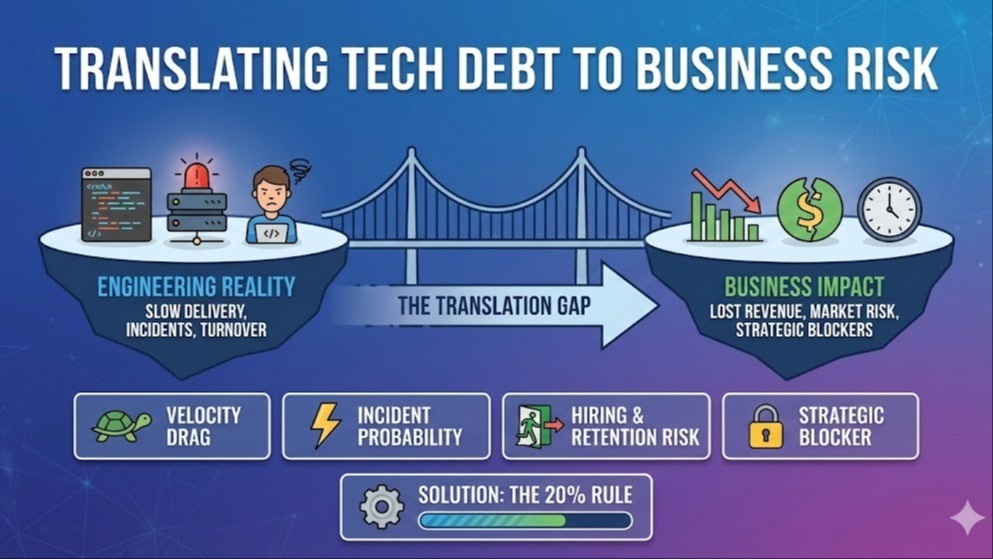
- The Tech Lead's Hardest Job: Translating "Technical Debt" into "Business Risk" for Executives
- Why Fast-Growing Companies Struggle With Tech Execution (And How to Overcome It)
- The Hidden Reason Most Tech Projects Fail — How Smarter Execution Fixes It
- Beyond Time Zones: The Engineering Playbook for High-Performance Distributed Teams
Need a senior engineering voice in the room?
Fractional CTO work: architecture calls, hiring, vendor review, and translating engineering risk into language your board acts on. Usually a few days a month, not a full-time hire.