Monolith to Microservices: The Honest Timeline, Budget, and Risk Nobody Talks About
A CTO once asked me: "How long will it take to move our monolith to microservices?"
I said, "What problem are you trying to solve?"
He paused. "I just assumed we needed to. Everyone says monoliths don't scale."
That conversation saved his company roughly $200,000 and 6 months of engineering time — because after digging into his actual situation, the answer was: he didn't need microservices at all. He needed better caching, a cleaner module structure, and a proper CI/CD pipeline.
When You Actually Need Microservices (And When You Don't)
You likely need microservices if:
- You have multiple engineering teams (10+ developers) and they're frequently blocked by each other during deployments
- Different parts of your system have fundamentally different scaling needs
- You have regulatory requirements mandating service isolation
- Deployment frequency is constrained by the size of the single codebase
You almost certainly don't need microservices if:
- You have a single development team of 3-8 people
- Performance problems are caused by missing caches, unoptimized queries, or poor infrastructure
- You're doing it because "everyone else is"
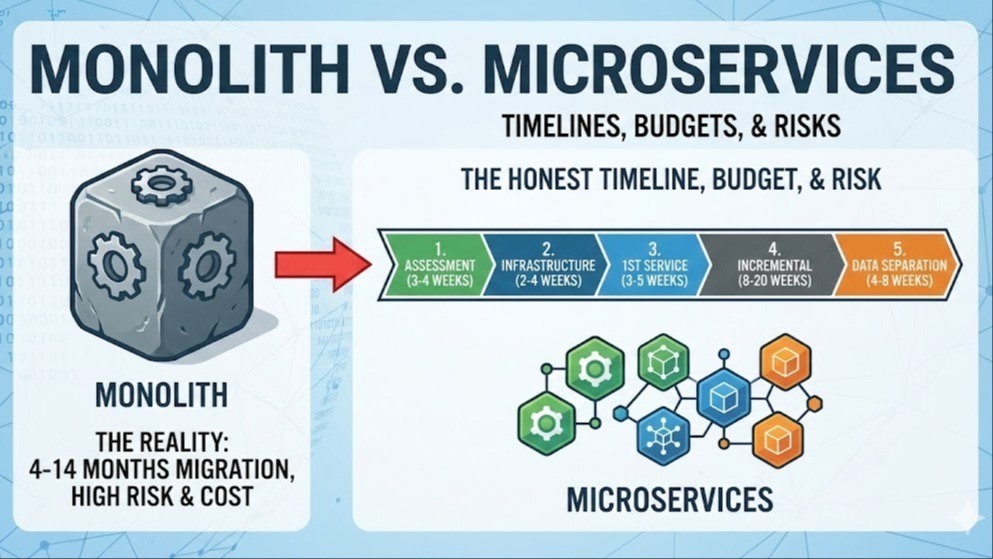
The Realistic Timeline
This assumes a mid-complexity application (50-100 API endpoints, 10-20 database tables, 3-5 major business domains).
Phase 1: Assessment and Domain Mapping (3-4 weeks) Creating a dependency map — every module's dependencies on every other module and database table. This reveals the natural "seams" in your monolith where you can extract services with least disruption.
Phase 2: Infrastructure Foundation (2-4 weeks) Before extracting any service, you need: service discovery, an API gateway, centralized logging, distributed tracing, and an independent CI/CD pipeline. Skipping this phase is the single most common mistake.
Phase 3: First Service Extraction (3-5 weeks) Start with a low-risk, well-bounded domain with minimal dependencies. The first extraction takes disproportionately long because you're building the template — deployment pipeline, inter-service communication patterns, testing framework, and operational playbook.
Phase 4: Incremental Migration (8-20 weeks) Each service follows the Strangler Fig pattern: build, shadow mode, gradual traffic shift, monitor, retire. Typically 2-4 weeks per service.
Phase 5: Data Separation (4-8 weeks) The hardest phase. Each service must own its data — its own database, no direct cross-service queries. This requires eliminating all shared database dependencies through APIs, data duplication with eventual consistency, or an event bus.
The Real Cost
For a mid-complexity migration:
- Engineering time: 6-14 months of 2-4 senior engineers = $200,000 to $700,000
- Infrastructure cost increase: 30-50% during migration (running both systems)
- Opportunity cost: Every sprint on migration is a sprint not spent on product features
- Ongoing operational cost: More sophisticated monitoring and dedicated DevOps capacity
The Risks Nobody Mentions
Distributed system complexity: Network failures, partial failures, data consistency issues, and cross-service debugging are fundamentally harder than anything in a monolith.
The "Distributed Monolith" trap: Wrong service boundaries, shared databases, or tight coupling through synchronous calls = all the operational complexity of microservices with none of the benefits.
Team readiness: Microservices require strong ownership, operational maturity, and comfort with autonomous decision-making. The cultural shift is as significant as the technical one.
My Recommendation: The Decision Matrix
Before committing, honestly evaluate:
Do you have 10+ developers? If not, invest in a better monolith.
Is deployment contention your primary bottleneck? If your bottleneck is performance or missing infrastructure, microservices will make things worse.
Can you afford 6-14 months of reduced feature velocity?
Do you have the operational maturity to run a distributed system today?
Originally published on LinkedIn
Related reading
- Monolith, Microservices, or Neither: An Honest Architecture Guide
- You Don't Need Kubernetes Yet: A Pragmatic Scaling Guide for Growing Startups
- The "Big Bang" Rewrite is a Trap: A Risk-Free Strategy for Legacy Modernization
- We Migrated a Legacy Java Backend to Node.js — Without a Single Day of Downtime. Here's How.
Not sure whether to split the monolith?
Tell me your user count, team size, and the part that hurts most. I will tell you whether your architecture is actually the problem — and I have talked plenty of founders out of a migration they did not need.