Stop Polling, Start Reacting: Why Event-Driven Architecture Is Your Competitive Advantage
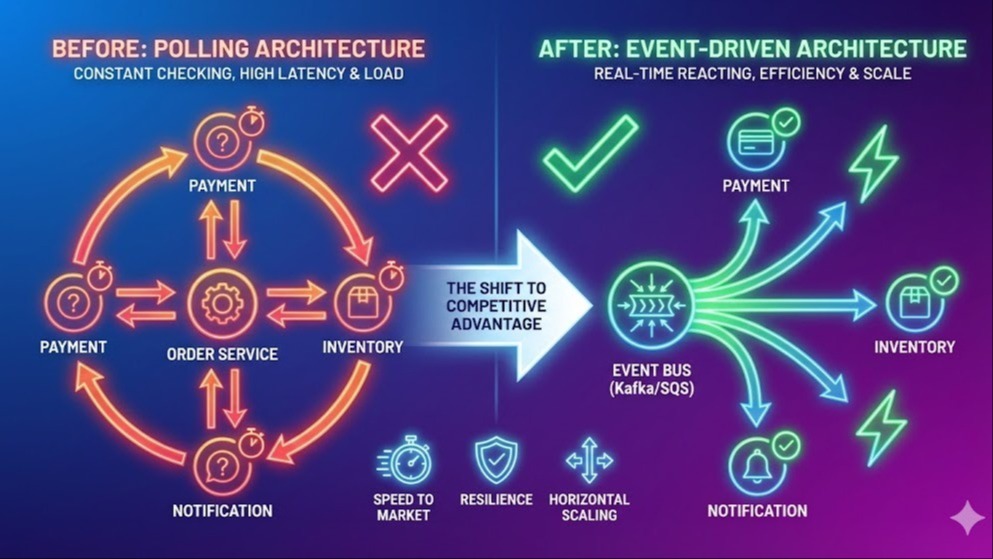
There's a pattern I see in almost every backend I'm asked to review: polling. The order service checks the payment service every 5 seconds: "Has the payment been confirmed?" The notification service queries the database every 10 seconds: "Are there new events?" The analytics dashboard refreshes every 30 seconds: "Is there new data?"
Each individual polling call is cheap. But multiply it across every service, every user, every second — and you're generating millions of unnecessary requests per day. Your database is spending more time answering "no, nothing has changed" than doing actual work.
This is the problem Event-Driven Architecture solves.
What Event-Driven Architecture Actually Means
The concept is simple. Instead of services constantly asking each other "did anything happen?", each service announces when something happens, and other services listen for announcements they care about.
When a user places an order, the Order Service publishes an event: Order Created. The Payment Service hears this and processes the payment. When payment succeeds, it publishes: Payment Confirmed. The Inventory Service reserves the stock. The Notification Service sends the confirmation email. The Analytics Service updates the dashboard.
No service is asking anyone anything. No service needs to know which other services exist. Each service does its job and announces the result.
Why This Matters for Your Business
Speed to Market
In a polling-based system, adding "send an SMS when a payment fails" requires modifying the payment service to call the SMS service. In an event-driven system, you build a new SMS service that listens for Payment Failed events. The payment service doesn't change at all.
I've seen this pattern reduce the time to add new integrations from 2-3 weeks to 2-3 days.
Resilience and Fault Tolerance
If the notification service goes down in a synchronous architecture, the order might fail. In an event-driven architecture, if the notification service goes down, the events wait in the message queue. When it comes back online, it processes the backlog. The user's order was never affected.
Horizontal Scaling
If your order volume doubles, you add more consumer instances. The event broker distributes the load automatically. I've seen this support a 10x traffic increase with minimal infrastructure changes.
Choosing the Right Event Backbone
For Most Startups (under 10,000 events/second): Managed message queues — AWS SQS with SNS, Google Cloud Pub/Sub, or Azure Service Bus. Fully managed, no infrastructure to maintain.
For High-Throughput Requirements: Apache Kafka excels when you need massive throughput (100,000+ events/second), event replay, long-term storage, and stream processing. Always use managed Kafka services (AWS MSK, Confluent Cloud) unless you have a dedicated platform engineering team.
The Hybrid Approach: Use Kafka for critical business events requiring durability and ordering. Use simpler queues (SQS/RabbitMQ) for lightweight operational events like notifications and logging.
Common Pitfalls
Event Spaghetti: Maintain a central event registry with schemas, producers, and consumers documented. Treat event schemas like API contracts — version them and never make breaking changes without migration support.
Eventual Consistency Confusion: Operations requiring immediate consistency (e.g., deducting a balance) should happen within a single service. Only the result (the event) is published asynchronously.
Lost Events: Configure your broker for at-least-once delivery. Design your consumers to be idempotent — processing the same event twice produces the same result as once.
Getting Started: The Incremental Approach
Step 1: Identify the highest-volume polling pattern in your current system. Convert it to event-based communication using a simple message queue. Measure the reduction in database load.
Step 2: Identify the integration point causing the most deployment friction. Introduce events at this boundary.
Step 3: As you extract services, make event-driven communication the default for inter-service communication.
Originally published on LinkedIn
Related reading
Not sure whether to split the monolith?
Tell me your user count, team size, and the part that hurts most. I will tell you whether your architecture is actually the problem — and I have talked plenty of founders out of a migration they did not need.