Stop Polling, Start Reacting: Why Fastest Companies Run on Event-Driven Architecture
The Limits of Request/Response
For years, we built systems using REST APIs. Service A needs data? It asks Service B. Service B asks the database. It works, but it's brittle. It creates tight coupling. Most importantly, it's slow.
In a hyper-speed market like Dubai — where 15-minute grocery delivery is the norm and logistics hubs move millions of parcels daily — the traditional "request/response" model is becoming a bottleneck.
You cannot build a real-time business on an architecture that has to "ask" for updates.
The future belongs to Event-Driven Architecture (EDA).
The Nervous System of the Enterprise
Instead of services calling each other directly, they publish "events" to a central nervous system — typically an event streaming platform like Apache Kafka.
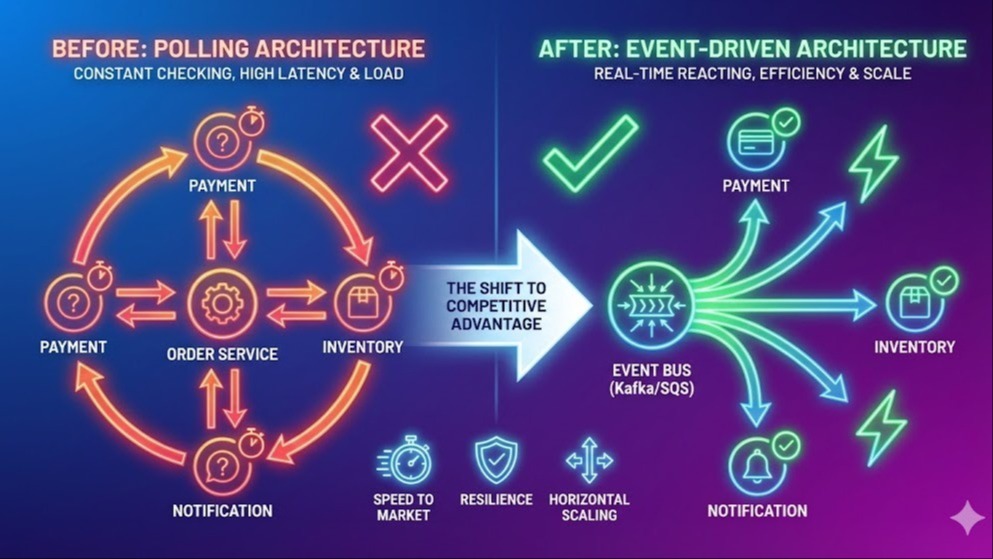
The Old Way (REST):
The Order Service calls the Inventory Service to reserve stock. Then it calls the Payment Service to charge the card. Then it calls the Shipping Service. If the Payment Service is down, the whole chain fails. The user waits.
The Event-Driven Way:
The Order Service simply publishes one event: OrderPlaced. It immediately confirms to the user. Done.
Why This Matters for Scaling
True Decoupling
The Order Service doesn't even know the Shipping Service exists. You can add new services (e.g., a "Loyalty Point Service") that listen to OrderPlaced without ever touching the core ordering code. This speeds up feature delivery immensely.
Resilience
If the Shipping Service is down for maintenance, the OrderPlaced event isn't lost. It sits safely in Kafka until the service comes back online and processes it. No data loss. No customer impact.
Real-Time Responsiveness
Instead of batch jobs running at midnight to update dashboards, dashboards update the millisecond an event occurs. In logistics, fintech, and e-commerce — milliseconds are competitive advantages.
The Maturity Shift
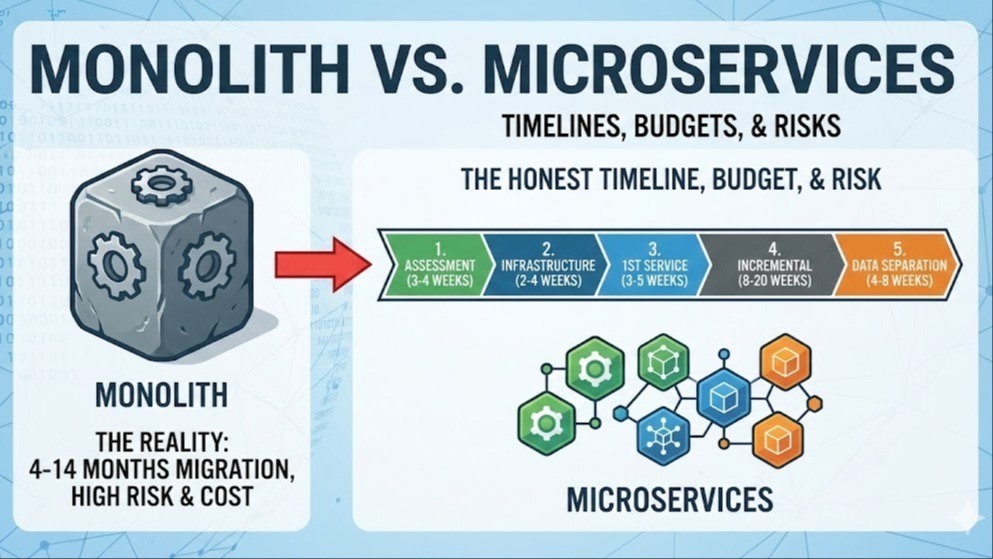
Moving from REST monoliths to Event-Driven microservices is a significant leap in architectural maturity. It requires:
- A shift in mindset — from "asking" to "announcing"
- Rigorous governance of event schemas and contracts
- Robust event streaming infrastructure (Kafka, RabbitMQ, AWS SNS/SQS)
- Disciplined handling of idempotency and at-least-once delivery
But for enterprises aiming to lead in logistics, finance, or e-commerce, an event backbone isn't just a technical choice — it's a competitive necessity for operating in real-time.
Originally published on LinkedIn
Related reading
Not sure whether to split the monolith?
Tell me your user count, team size, and the part that hurts most. I will tell you whether your architecture is actually the problem — and I have talked plenty of founders out of a migration they did not need.