We Migrated a Legacy Java Backend to Node.js — Without a Single Day of Downtime. Here's How.
The directive from leadership was clear: "We need to move faster. Our competitors are shipping features weekly. We're shipping monthly — at best."
The problem wasn't the team. The problem was the stack. The platform was running on a legacy Java monolith. Every small change required a full build-and-deploy cycle that took hours. Adding a new content type or changing an API response format turned into a multi-week effort.
My mandate: migrate the backend from Java to Node.js without disrupting the live platform. Not even for a minute.
Why Node.js? The Business Case First
Before any code was written, I had to make the case to people who didn't care about JavaScript or event loops. The argument wasn't technical — it was operational.
- Developer velocity: The Java team had 4 backend developers. Finding experienced Java developers for this specific stack was taking 3-4 months per hire. Node.js had a dramatically larger talent pool.
- Deployment speed: The Java monolith had a 45-minute build cycle. A Node.js service could be built and deployed in under 3 minutes.
- Operational simplicity: Node.js ran lighter, required less infrastructure, and aligned with our containerized future.
- Cost: Fewer servers, faster deploys, and a larger hiring pool all translated directly to lower operational cost.
The Strategy: The Strangler Fig Pattern
The single most important architectural decision was choosing the Strangler Fig migration pattern over a Big Bang rewrite.
A Big Bang rewrite means building the entire new system in parallel and switching over on a single day. It sounds clean. In practice, it's a disaster — you're maintaining two full codebases for months, the new system has no production battle-testing, and the switchover is a single point of failure.
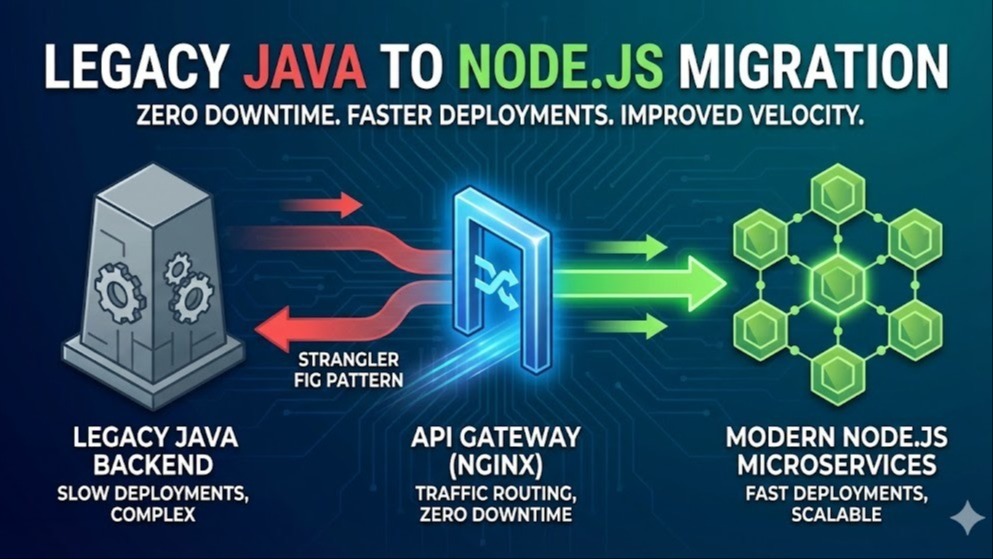
The Strangler Fig approach: Build new functionality in Node.js while the old Java system continues to run. Route traffic incrementally — one endpoint at a time — from old to new. Over time, the new system "strangles" the old one until nothing is left.
Phase 1: The API Gateway (Weeks 1-3)
The first thing I built was an API Gateway — a thin routing layer using Nginx that sat in front of both the Java backend and the new Node.js services.
All incoming traffic hit the gateway first. By default, everything was routed to Java. But the gateway could be configured, on a per-endpoint basis, to route requests to the new Node.js service instead.
This meant we could move one endpoint at a time, test it with real traffic, and roll back instantly by changing a single routing rule. No deployment needed. No downtime.
Phase 2: Low-Risk Endpoints First (Weeks 3-8)
We started with the least critical, lowest-traffic endpoints. The first was the "contact us" form submission API. Almost no traffic. Zero revenue impact.
Each migration followed the same checklist:
Build the endpoint in Node.js with comprehensive logging
Shadow testing — run both systems in parallel; only Java response returned to user, but Node.js response logged and compared
If responses matched consistently for 48 hours, proceed
Gradual traffic shift — 5% → 25% → 50% → 100%
Retire the Java endpoint after 2 weeks at 100%
Phase 3: High-Traffic, Revenue-Critical Endpoints (Weeks 8-14)
For the article rendering API, homepage content feed, and search endpoint, I added two additional safeguards:
Circuit breaker pattern. If the new Node.js endpoint's error rate exceeded 1% within any 60-second window, the gateway automatically routed all traffic back to Java. An automated safety net — no human had to be monitoring at 3 AM.
Performance benchmarking. Before going live, I ran load tests simulating peak traffic (roughly 3x normal load). Node.js endpoints had to match or beat Java on response time, error rate, and memory usage.
In practice, the Node.js endpoints were 30-40% faster than the Java equivalents for read-heavy operations.
Phase 4: Database Layer and Cleanup (Weeks 14-18)
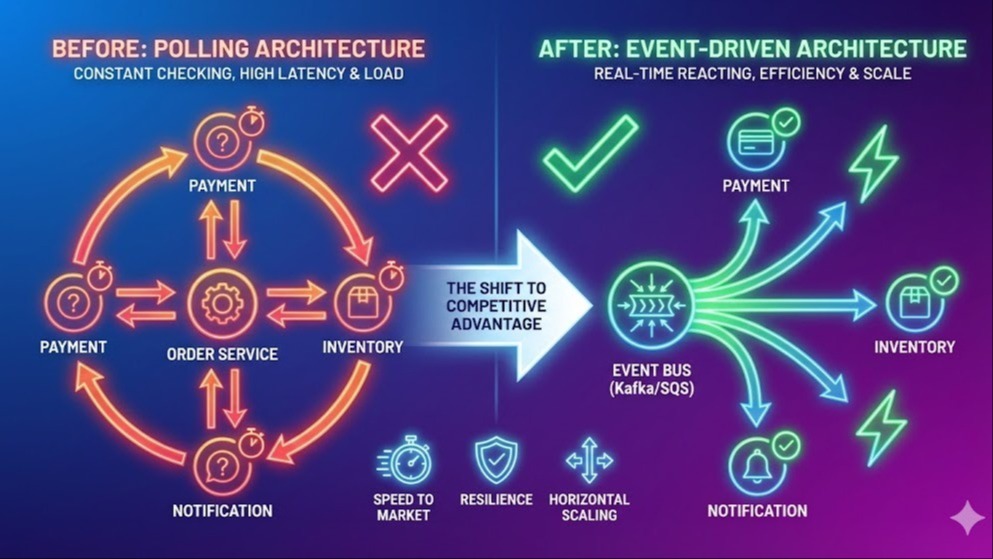
Both services were reading from and writing to the same database during transition. For operations involving multiple sequential writes, I introduced a simple event queue to prevent race conditions. When either service performed a write that other services depended on, it published an event. Dependent services listened for those events instead of polling the database.
The Results
| Metric | Before | After |
|---|---|---|
| Downtime | — | Zero |
| Build & Deploy | 45 minutes | Under 3 minutes |
| Average API Response Time | baseline | 35% improvement |
| Time to hire new developers | 3-4 months | 6 weeks |
The Playbook: What I'd Tell Any CTO
Don't rewrite. Strangle. The Strangler Fig pattern eliminates the biggest risk — the Big Bang cutover.
Start with the business case, not the technology case. Your CFO cares about deployment speed, hiring costs, and infrastructure spend.
Shadow test everything. Running both systems in parallel and comparing outputs is the cheapest insurance you can buy.
Automate your rollback. Circuit breakers and gateway routing rules mean you can undo any change in seconds, not hours.
Budget for cleanup. The migration isn't done when the new code is running — it's done when the old code is archived and the team understands the new architecture. Budget an extra 3-4 weeks.
Originally published on LinkedIn
Related reading
- Monolith, Microservices, or Neither: An Honest Architecture Guide
- The 'Context Window' Paradox: Why Fragmented Microservices Are Sabotaging Your AI Strategy
- Stop Polling, Start Reacting: Why Event-Driven Architecture Is Your Competitive Advantage
- Stop Polling, Start Reacting: Why Fastest Companies Run on Event-Driven Architecture
Not sure whether to split the monolith?
Tell me your user count, team size, and the part that hurts most. I will tell you whether your architecture is actually the problem — and I have talked plenty of founders out of a migration they did not need.