Beyond the Hype: The Engineering Reality of Running Generative AI in Production
The "Demo vs. Production" Trap
In boardrooms around the world, the directive is the same: "We need GenAI in our product by next quarter."
Building a prototype that calls an LLM API to summarize text or answer a question takes an afternoon. It looks stunning in a controlled demo environment.
But taking that demo into production at enterprise scale? That is where the real engineering nightmare begins.
As Technical Leads and Architects, we know that "integrating AI" isn't a data science problem anymore — it's a distributed systems problem. We are trading deterministic code (where if X then Y always happens) for probabilistic responses, and this fundamental shift breaks traditional backend architectures.
Here are the three biggest engineering hurdles teams face when pragmatically integrating GenAI at scale.
1. The Latency Bottleneck & The "Streaming" Imperative
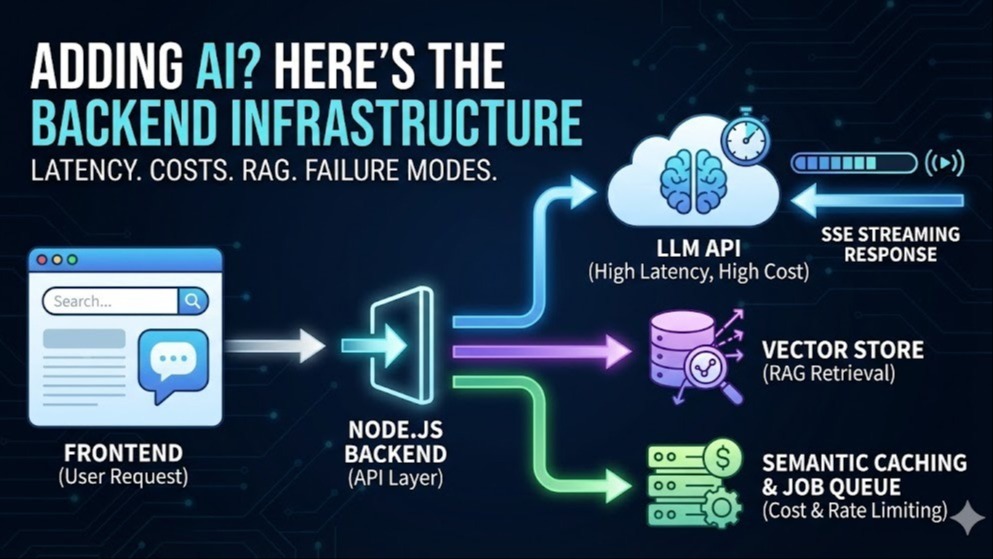
A standard backend REST API call should return in under 100ms. An LLM inference call might take 5 to 15 seconds.
If your standard backend server (e.g., Node.js or Python) waits synchronously for that response, you will exhaust your connection pool instantly under load. One slow AI call blocks a thread. A hundred simultaneous users bring your entire backend to a crawl.
The Engineering Fix:
You cannot treat LLMs like standard APIs. We must architect for Server-Sent Events (SSE) or WebSockets to stream responses token-by-token to the frontend as they are generated. The backend must become fully asynchronous, decoupling request ingestion from response generation to prevent thread-blocking.
This transforms the user experience from "I waited 12 seconds for a response" to "text started appearing immediately."
2. The Context Window Challenge (RAG Architecture)
An LLM doesn't know your company's private data, customer history, or internal documentation. Sending a 50-page PDF in every prompt context window is too slow, too expensive, and often exceeds token limits.
The Engineering Fix:
We need robust RAG (Retrieval-Augmented Generation) pipelines. This means architecting systems that:
The backend engineering challenge is building the highly efficient "search and retrieval" step before the generation step even begins. When a user asks a question, you first retrieve the most relevant chunks from your vector store, then inject them into the prompt context. The LLM answers based on your data, not just its training data.
3. Cost & Rate Limit Governance
Giving every user in a global application direct, unfettered access to a powerful model like GPT-4 is a recipe for either bankruptcy or denial-of-service via vendor rate limits.
The Engineering Fix:
We need an intelligent AI middleware layer that implements:
- Semantic caching — caching similar prompts vectorially to avoid re-computing the same answers. If 100 users ask the same question differently, you only pay for the LLM call once.
- Distributed queueing systems (like Kafka or Redis Streams) to throttle requests, manage quotas per tenant, and control costs proactively
- Hard budget caps at the API level, with fallback behaviour when limits are reached
- Token counting before sending requests — if a prompt exceeds your maximum token budget, truncate context rather than sending an unexpectedly expensive call
The Global Enterprise Reality
Across every industry, the mandate to integrate AI is massive. But as these initiatives move from innovation labs to core product teams, the realization hits hard:
AI isn't just a feature. It's a new, volatile type of infrastructure workload.
Success at global scale won't come from hiring more prompt engineers. It will come from robust backend architecture that can handle the unique latency, cost, and unreliability profile of probabilistic models.
We need to build the robust plumbing that makes the magic usable.
Originally published on LinkedIn
Related reading
- Shipping AI Features to Production: The Backend Nobody Talks About
- Adding AI to Your Existing Product? Here's the Backend Infrastructure Nobody Talks About.
- Scaling AI-Driven Engineering: Why Unstructured Frameworks Are Costing Your Team 30% in Velocity
- Building AI-Powered Web Applications: A Complete Guide
Adding AI to an existing product?
The model is the easy part. Send me what you are building and I will map the backend work it actually implies — retrieval, cost ceilings, latency budget, failure modes — before you commit a sprint to it.