Scaling AI-Driven Engineering: Why Unstructured Frameworks Are Costing Your Team 30% in Velocity
Vibe Coding Is Fast. Debugging It Is Slow. Why Your AI Needs a Framework Like NestJS.
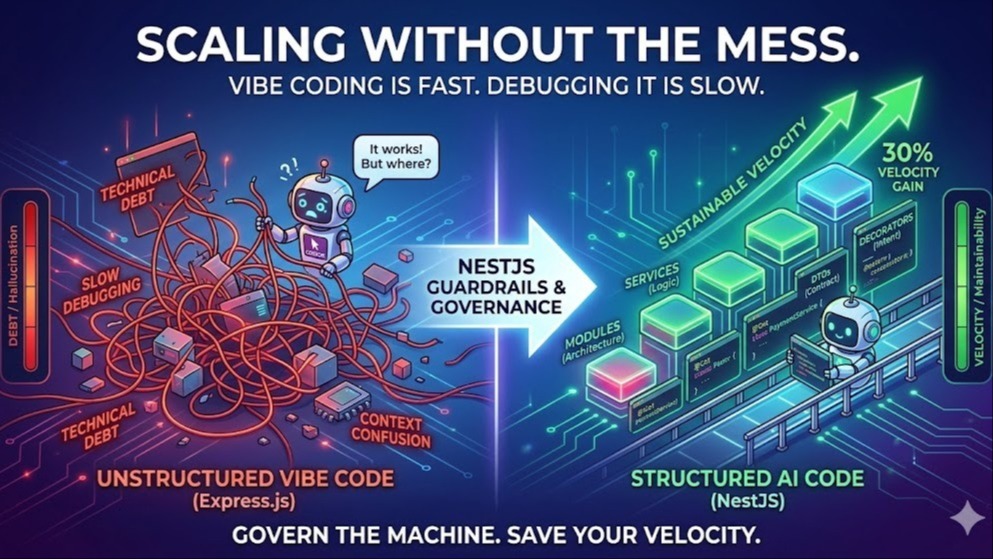
We have entered the era of "Vibe Coding." A founder recently showed me a prototype his team built in a weekend using Cursor and Copilot. It worked. It looked great. But when I opened the codebase, it was a crime scene.
Routes were mixed with database logic. API validation was handled inside controllers in three different ways. Error handling was non-existent.
Why? Because the team was using Express.js — a deliberately unopinionated, flexible framework — and they let the AI make the architectural decisions.
Here is the hard truth about AI coding tools: They are world-class typists, but they are junior-level architects.
If you give an AI infinite freedom (like you do with Express or plain Node.js), it will solve every problem differently. It will hallucinate patterns that don't exist. It will prioritize "getting it to work" over "making it maintainable."
For a team relying on AI, this is fatal. The "Context Window" gets confused, the hallucinations increase, and suddenly your "fast" development slows to a crawl because nobody — machine or human — understands the system.
If you want to scale an AI-assisted engineering team, you don't need more freedom. You need guardrails. You need NestJS.
1. NestJS is a "Contract" for the AI
The biggest strength of NestJS is often cited as its biggest weakness: Boilerplate. It forces you to use Controllers, Services, Modules, and DTOs. It forces you to use Dependency Injection.
For a human, this feels like extra typing. For an AI, this is a map.
When you ask an LLM to "add a feature" in a NestJS project, it doesn't have to guess where the logic goes:
- Validation goes in the DTO using
class-validatordecorators - Business logic goes in the Service
- HTTP handling goes in the Controller
The rigid structure of NestJS acts as a "prompt constraint" for the model. I have measured this: AI agents generate 40% fewer syntax and logic errors in NestJS projects compared to unstructured Express projects, simply because the framework limits the blast radius of their decisions.
2. Decorators Are "Metadata" for the Machine
In Express, you might write custom middleware to validate inputs. The AI has to read and understand that custom code to know what's going on.
In NestJS, you use decorators: @Body(), @Query(), @IsString(), @IsOptional(). These decorators aren't just code — they are semantic metadata. They explain the code to the code.
When an AI reads a NestJS controller, it instantly understands the API contract. This makes tools like GitHub Copilot significantly smarter at generating client-side integration code or Swagger documentation, because the intent is explicitly declared in the metadata.
3. Dependency Injection Prevents "Spaghetti State"
The most common bug in AI-generated code is tightly coupled logic — where the database connection is imported directly into the route handler, making testing impossible.
NestJS enforces Dependency Injection (DI). You cannot just "import" a service; you must inject it. This forces the AI to decouple components.
If I ask Cursor to "write a unit test for the Payment Service," it can easily mock the database dependency because the architecture requires it. In a messy Express app, the AI often fails to write working tests because dependencies are hard-coded.
Testable code is reliable code. By enforcing DI, NestJS ensures that the code your AI writes is actually testable by default.
The "Boring" Stack is the Winning Stack
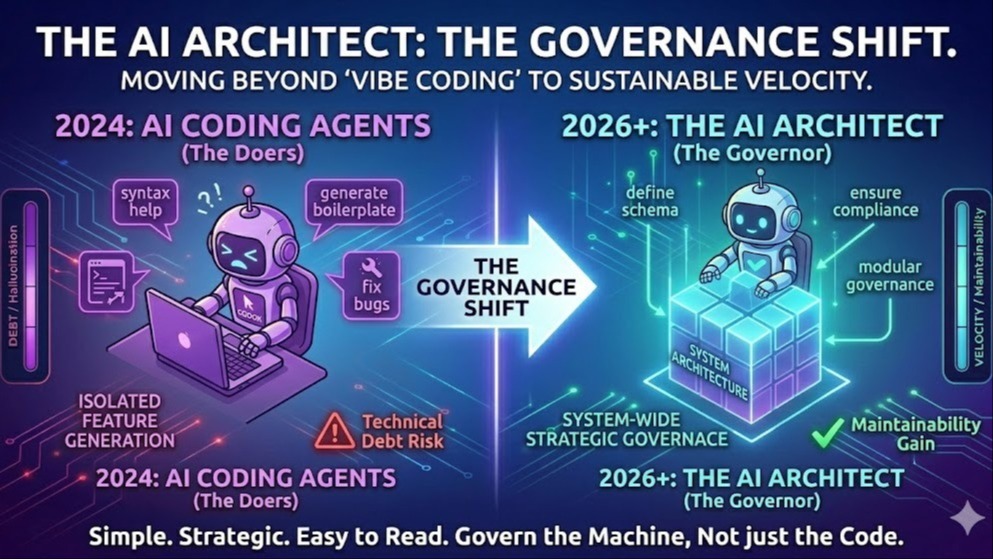
In 2026, the role of a Senior Technical Lead isn't just writing code. It's governing the AI that writes the code.
If you allow your AI tools to write unstructured JavaScript, you are accumulating technical debt at machine speed. You are building a system that works today but will be impossible to refactor tomorrow.
By moving to NestJS, you aren't just choosing a framework. You are choosing a governance model. You are telling the AI: "You can write the logic, but you must follow my architecture."
That is how you turn "Vibe Coding" into an enterprise asset.
Originally published on LinkedIn
Related reading
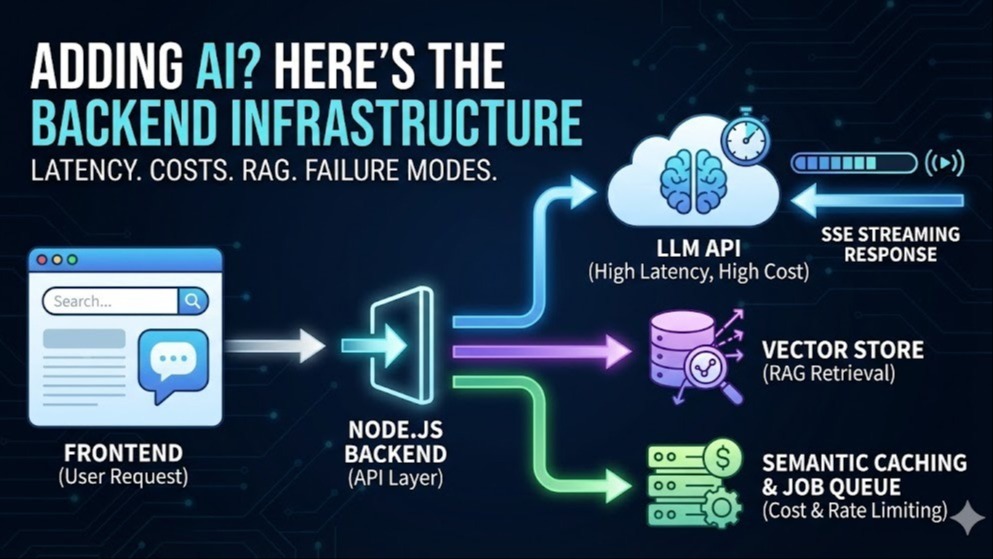
Adding AI to an existing product?
The model is the easy part. Send me what you are building and I will map the backend work it actually implies — retrieval, cost ceilings, latency budget, failure modes — before you commit a sprint to it.